
Your profit and loss statement can be completely accurate and still not match your bank account. A P&L counts income the day you earn it and expenses the day you incur them, not the day cash moves. The profit on that report is real. It has gone to places the P&L was never built to show.
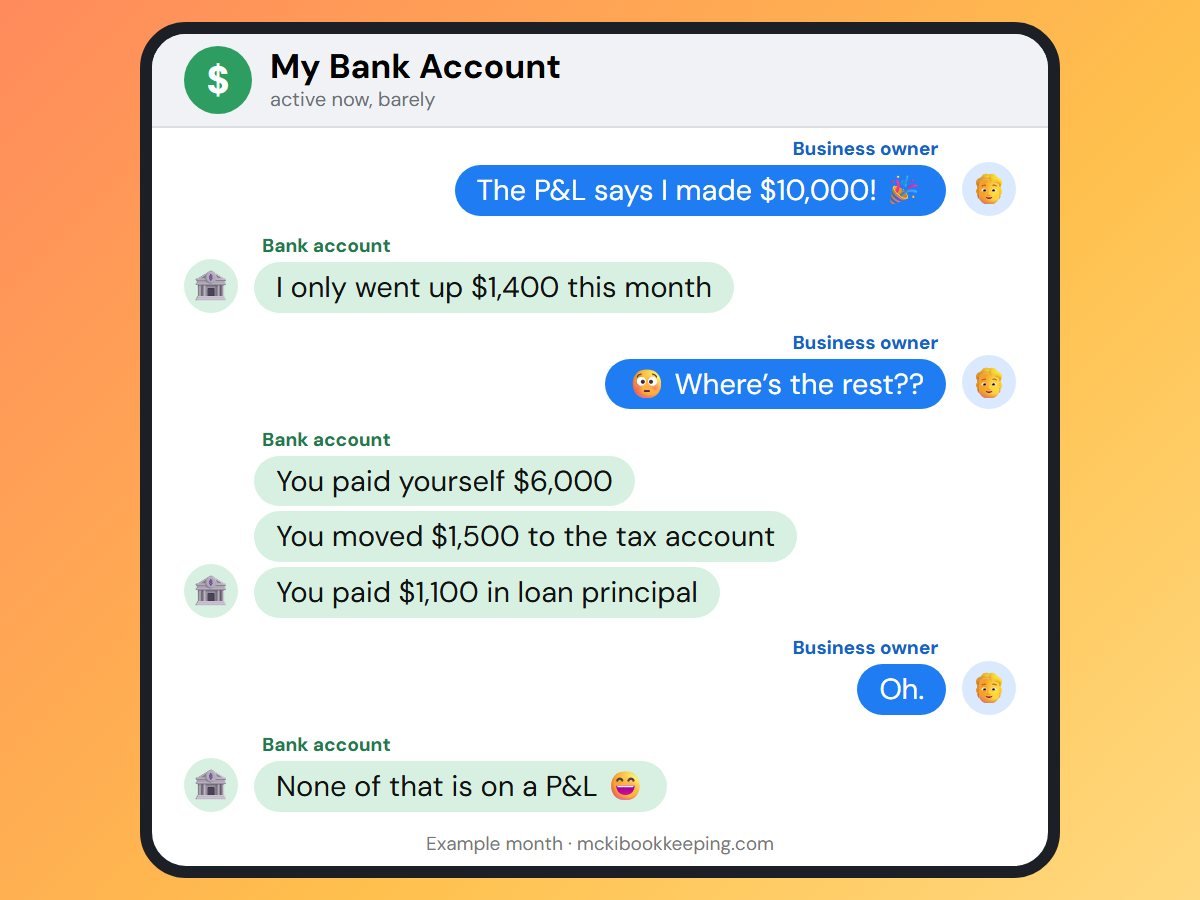
When I put a client's P&L next to their bank statement and the two don't line up, the gap is usually one of five things. This assumes accrual reports. On a cash-basis P&L, unpaid invoices aren't counted yet, and inventory may be handled differently.
The five places profit disappears to
- Money customers owe you. A P&L counts a sale the day you invoice it, not the day the customer pays. So if you invoiced $20,000 this month and collected $12,000 of it, the P&L shows $20,000 in revenue, and your bank account only has $12,000 to show for it. The other $8,000 is real profit. It is sitting in an unpaid invoice, waiting to be collected.
- The principal portion of a loan payment. A loan payment splits into interest and principal. Only the interest counts as a P&L expense; the principal pays down a balance on the balance sheet instead. If your payment is $1,500 a month and $1,100 of that is principal, that $1,100 leaves your bank account every month without ever touching your P&L.
- What you paid yourself. A draw is not a business expense. It is money you take out of profit after the fact, so the P&L never records it. If the business earned $10,000 this month and you drew $6,000 for yourself, the P&L still shows $10,000 in profit, and your bank account is $6,000 short of that number.
- Inventory or equipment you paid for in cash. Buying inventory moves cash onto a shelf, not onto the P&L. The cost only shows up as an expense later, when that inventory sells. So if you spent $15,000 restocking and sold a third of it by month end, the P&L only reflects $5,000 of that as cost of goods sold. The other $10,000 left your bank account and is sitting in boxes.
- Cash you have set aside for taxes. Moving money into a separate account for your next estimated tax payment does not touch the P&L at all, because you have not bought or used anything the business needed. It still counts as profit until the day you send it to the IRS.
What to check instead
Comparing one month's profit to today's bank balance is the wrong comparison. Profit is a total for the month. Your bank balance carries the weight of every month before it. Compare that month's profit to how much your bank balance changed during that same month, and most of the five items above explain the difference. A cash flow statement sorts that change for you, splitting it into what came from running the business, what went to loans and equipment, and what you drew out.
A bookkeeper can pull a cash flow statement for you alongside the P&L, and it will point straight at whichever of these five is eating your cash this month.
Your books are not wrong. Profit and cash answer two different questions, and a healthy business needs to track both.